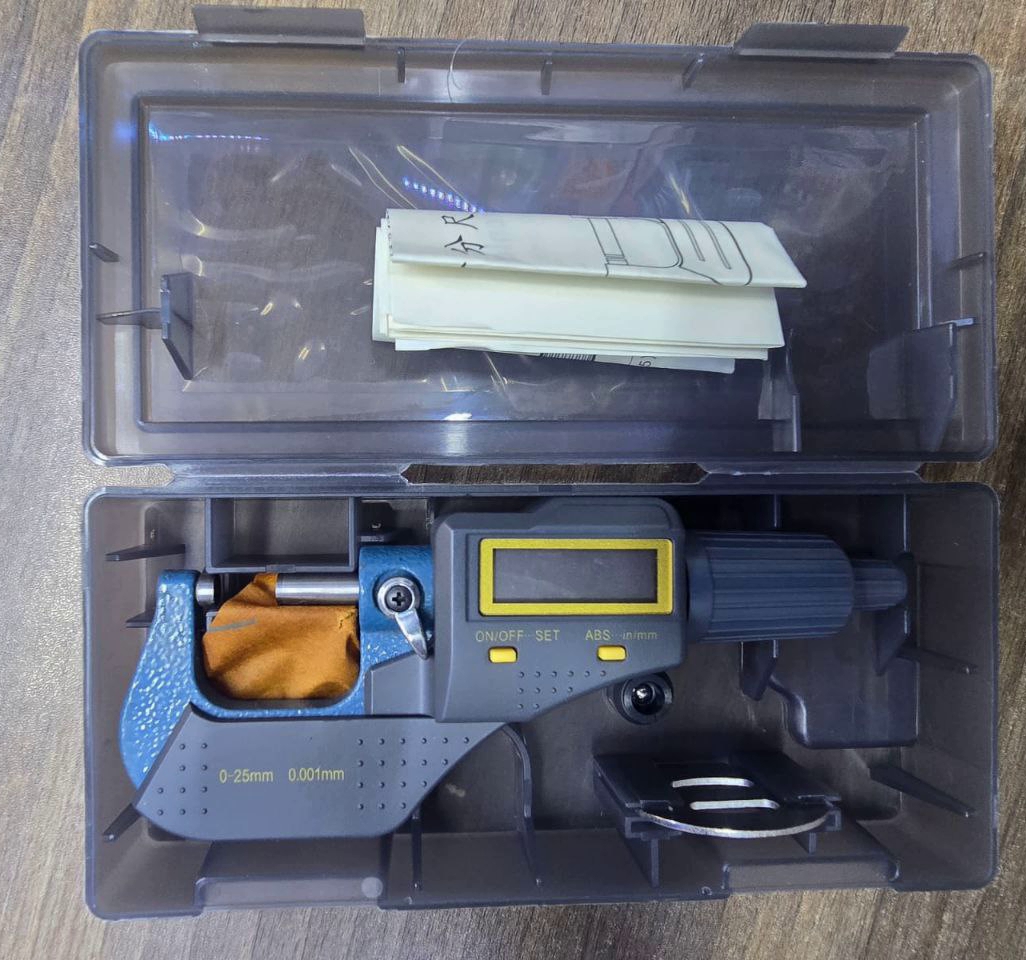
Digital micrometer screw gauge
$ 48.75
Key Features and Advantages: High Accuracy and Resolution: Digital micrometers are known for their exceptional precision. While analog micrometers typically have a least count of 0.01mm, digital micrometers can often achieve resolutions of 0.001mm (or 0.00005 inches), and some high-end models even offer 0.1µm (0.0001mm) resolution. This makes them ideal for applications where even minute deviations are critical. Easy to Read: The digital display eliminates the need for manual interpretation of scales, significantly reducing the chance of reading errors and speeding up the measurement process. Unit Conversion: Most digital micrometers allow for quick and easy switching between metric (mm) and imperial (inches) units with the press of a button. Zero Setting at Any Position (ABS function): This allows for relative measurements or comparison measurements, where you can zero the display at any point and measure deviations from that point. Data Output: Many advanced digital micrometers come with data output ports (e.g., USB, Bluetooth) to transfer measurements directly to a computer for data analysis, documentation, or statistical process control (SPC). Reduced Human Error: The digital readout and consistent force mechanism (ratchet stop) minimize the influence of operator variability. Automatic Power-Off: To conserve battery life. Durable Construction: Often features hardened steel bodies, carbide-tipped measuring faces, and can be oil-resistant.